
How Mercedes-Benz chose Tempe, Arizona for its newest charging site — and made the numbers work
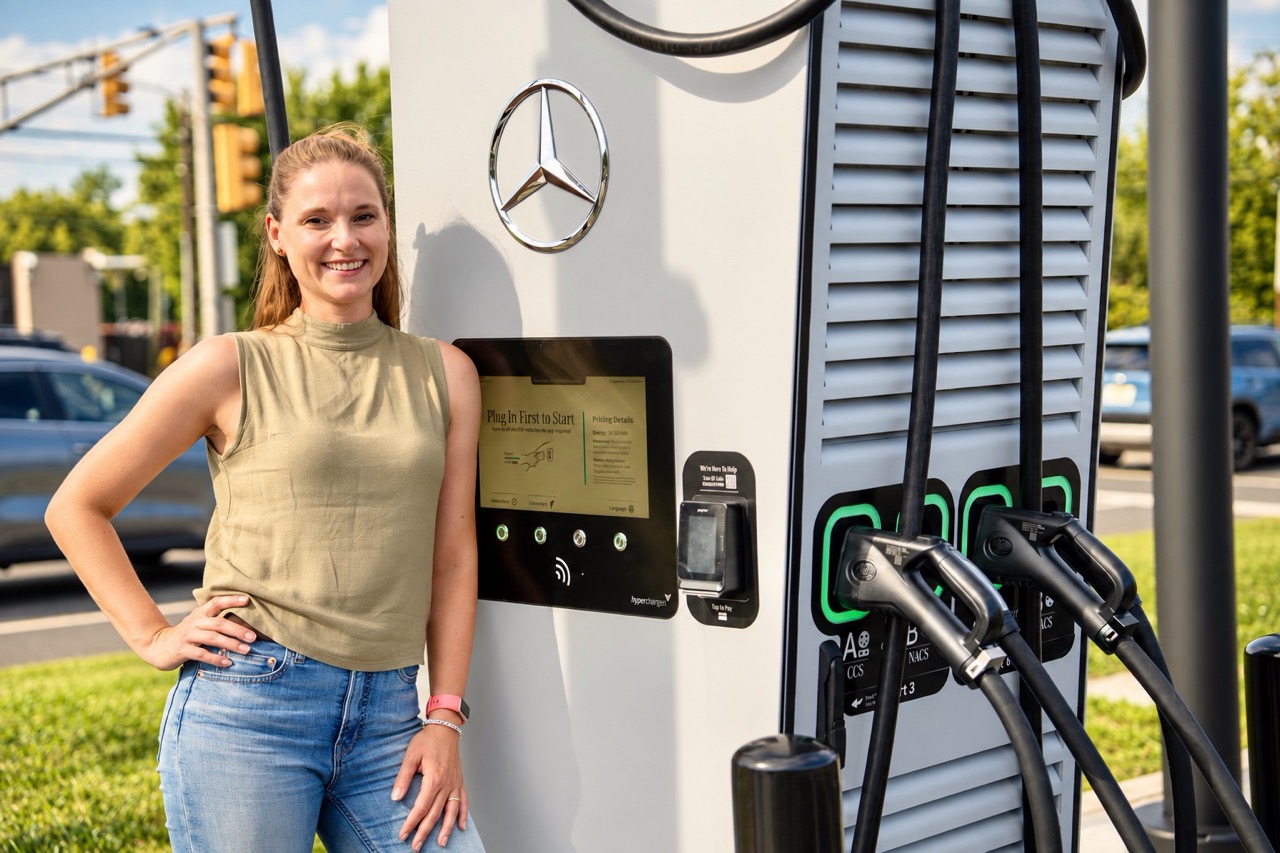
What logo do you want on your center? Mercedes' or a relatively unknown brand?
When you're the custodian of one of the world's most valuable and recognizable luxury brands, you must ensure that every venture in which you engage only increases, rather than denigrates, its value.
That was the challenge that Mercedes-Benz faced when it decided to enter what has to date been a rather mixed-bag business: high-speed electric vehicle charging in the U.S. The company knew that there was still a dearth of available charge points for EV drivers. But it had to guarantee that it would offer a charging experience as high-end and reliable as its vehicles.
For EV charging, that meant offering consumers stations that consistently worked and charged at the advertised speed, and were in areas that offered desirable amenities. As owners know, it's bad enough waiting 30 minutes for a charge to complete; nobody's happy when they have to spend twice that amount of time because only a handful of stalls are operating and doing so at a glacial speed.
Mercedes knew that if they could do it right, the initiative could have a great knock-on effect, bringing more people closer to the Mercedes name and raise the industry-wide standards for public charging.
But at the same time, Mercedes was not interested in running a charity. "This had to be a sustainable business," said Madeline Ebert, Mercedes-Benz's head of Product & Driver Experience for its High-Power Charging division.
Figuring out where there's an undersupply of charging stations as well as locations to which drivers would gravitate is not a seat-of-the-pants decision.
"We knew that we needed to make data driven decisions on what areas we should enter," Ebert said.
But just having the data wasn't going to be enough. It had to be interpreted properly. And that was a job for humans, not AI.
Site selection would be carefully determined. The company wasn't interested in building a coast-to-coast network. Instead, it wanted to identify areas that present consumers with a venue that they look forward to visiting, have industry-leading station/network uptime, and where profitable rates could be charged.
One year ago, Ebert and her colleagues realized that those criteria looked promising for what could become its latest addition to its 900 charging stalls now available in 28 states and British Columbia.
The Tempe Marketplace, in Tempe, AZ, seemed to tick all the boxes: the state has a high penetration of EVs, and the site itself looked ideal: an outdoor mall with such high-end retailers as Barnes & Noble, Best Buy, H&M, Sephora, lululemon, and others.
Mercedes' organization team visited the property and found that it had good amenities, including a car wash, fast casual restaurants, extensive parking, clean restrooms, and a well-lit parking area close to a nearby highway.
Utilizing Paren's session and pricing data, Ebert saw that the competitors' EV charging stalls were oversubscribed. When available chargers hit an average utilization threshold, drivers often experience queuing and must wait for an available stall. Once drivers of ICE vehicles notice lines at chargers, their prejudice against owning an EV is reinforced, making them less likely to make the switch.
In Tempe, the utilization rate at nearby chargers indicated demand was seriously outstripping supply.
While the site looked promising, Mercedes' finance team needed to make sure that there would be a good ROI. Once electric utility rates went down in the evening, Mercedes could implement time of use pricing. But it needed to understand demand at different intervals of the day to encourage off peak use while still capturing drivers during peak hours. Paren's pricing data indicated that charging was happening not just in the evening but throughout the day, ensuring that its charging stalls would not get backed up and turn off drivers passing by.
With both ROI and site selection criteria confirmed the Mercedes team negotiated a long-term lease with the Marketplace's landlord. "We had several charging competitor companies vying for the space," Ebert recalled. "But it came down to, what logo do you want on your center? Mercedes' or a relatively unknown brand?"
Mercedes' newest charging location just opened this July; as a result, its success is too early to confirm. But Ebert is bullish that it will be a high performing site. To do so, Mercedes will continue to use Paren's data long after the charging station has been up and running.
The Mercedes-Benz Charging Network continues its steady growth toward 1,000 ports, with nearly double the sites in the development pipeline. To get there, the company plans on keeping their important alliance with Paren.
"We continue to benefit from the partnership with Paren," Ebert said. "From them I can learn about how our monthly market share and our pricing compares to our competitors."
"If I'm losing customers, Paren's insights allow me, in consultation with my colleagues, to determine if we need to increase our advertising spend or dynamically change pricing to bring in more customers."
"Paren does not run our business," Ebert added. "Rather, it gives us the foundation that we need to then allow our human colleagues to make the ultimate, data-driven decisions."
"We couldn't be happier with the partnership."
We couldn't be happier with the partnership.